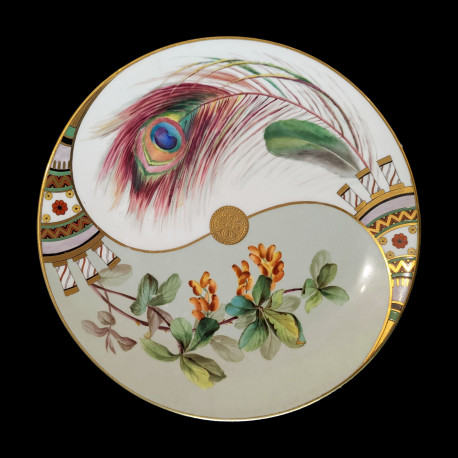



Rare cabinet plate decorated with a peacock feather and a branch of Japanese barberry in a composition evocative of the Yin and Yang symbol. Produced by the Minton manufactory in 1876, with a design attributed to Christopher Dresser. A remarkable example of the Aesthetic Movement, created for discerning collectors of nineteenth-century porcelain.
An elegant cabinet plate divided into two reserves: the upper reserve is decorated with a magnificently painted peacock feather accompanied by a smaller green feather; the lower reserve features a naturalistically painted branch, probably depicting Japanese barberry . Framing the composition on either side are richly ornamented geometric motifs recalling Japanese fans or textile panels. The decoration is enhanced throughout with finely burnished gilding, including the rim, the dividing lines and the central medallion.
Christopher Dresser ranks among the most innovative and influential designers of the nineteenth century and is widely regarded as one of the first independent industrial designers. He designed across an astonishing range of media—including ceramics, glass, metalwork, furniture, wallpapers and textiles—and worked for many of Britain's leading manufacturers. His celebrated visit to Japan in 1876, undertaken as an official government representative, profoundly reinforced his admiration for Japanese aesthetics and contributed significantly to the development of the Anglo-Japanese style in Britain.
Christopher Dresser's association with Minton & Co. appears to have begun in the mid-1860s and continued until about 1880, although the precise dates remain uncertain. Minton, then Britain's foremost ceramic manufacturer, actively commissioned designs from leading artists and architects, and Dresser became one of the firm's most original contributors. His designs are distinguished by bold asymmetrical compositions, stylised botanical forms, feathers, insects and birds, reflecting Japanese artistic principles, of which the present plate is an excellent example.
Rare cabinet plate decorated with a peacock feather and a branch of Japanese barberry in a composition evocative of the Yin and Yang symbol. Produced by the Minton manufactory in 1876, with a design attributed to Christopher Dresser. A remarkable example of the Aesthetic Movement, created for discerning collectors of nineteenth-century porcelain.